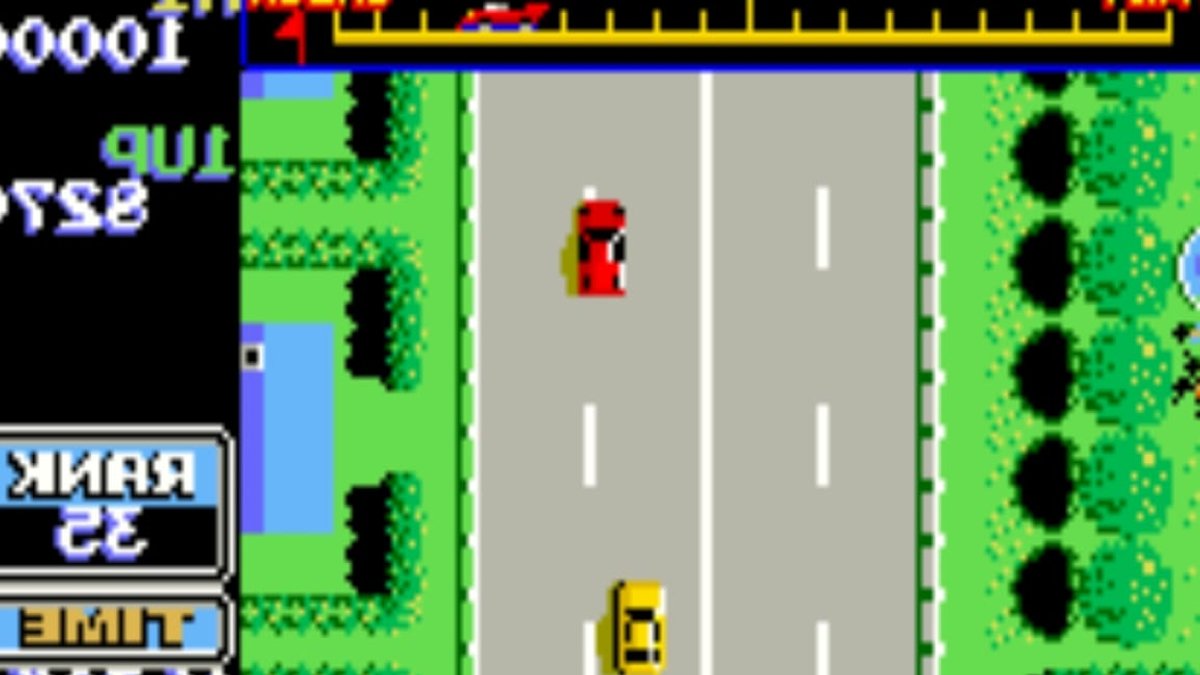
In 1984, Konami released Road Fighter, a top-down arcade racer that shared no connection with Street Fighter despite the similar name. The game wasn’t the first to use a bird’s-eye view for driving, but it stood out for one reason: speed. Not the kind that made players feel heroic, but the kind that forced them into a flow state just to survive.
The illusion of a 2,400-horsepower Corvette
The player’s car appeared as a Corvette on the title screen, though its specifications were pure fantasy. A V12 engine producing 2,400 horsepower would have been absurd even in the 1980s, a decade not known for restraint. Real Corvettes of the era barely reached 200 horsepower. The game’s version, however, left fighter jets and superheroes behind.
That power wasn’t decorative. Road Fighter required constant focus. The road ahead became a gauntlet of oncoming traffic, narrowing to two lanes at its most challenging. A single mistake meant instant failure. The game’s strength lay in turning congestion into a high-speed puzzle, where every vehicle on screen had to be dodged in real time. Hesitation wasn’t an option.
Related: Affordable Type R models now on market
It emphasized endurance over racing. Tracks were short, but the chaos never let up. Players who lasted more than a few seconds had already defied expectations. The scenery blurred into streaks of color, creating an effect that made the game feel faster than it was. The disorientation kept players engaged with the controls.
A lasting influence
Road Fighter never achieved the fame of Out Run or Pole Position, but its impact endured. Konami returned to the formula under different names—Konami GT, Midnight Run, and Winding Heat—each version refining the same idea. The final release, Road Fighters in 2010, was a Japan-only compilation that included tracks from other Konami racers like Enthusia Professional Racing and GTI Club.
The 2010 version arrived 26 years after the original arcade game. Chevrolet still hasn’t produced a Corvette with that much power. The game’s engine remains a fantasy.
Related: Lightweight 993 packs modest 455bhp punch
The game worked because it turned traffic into the real opponent. Most racing games focused on competing against other drivers. This one made the road itself the challenge. The result was a rare balance of reflexes and patience. Winning wasn’t the goal—avoiding failure was.
Decades later, the game’s simplicity remains appealing. There are no open worlds, no microtransactions, and no complex stories. Just a car, a road, and the constant risk of crashing. While modern racing games pursue realism, Road Fighter succeeded by ignoring it. It delivered the thrill of barely keeping control—and the relief of reaching the finish line.


