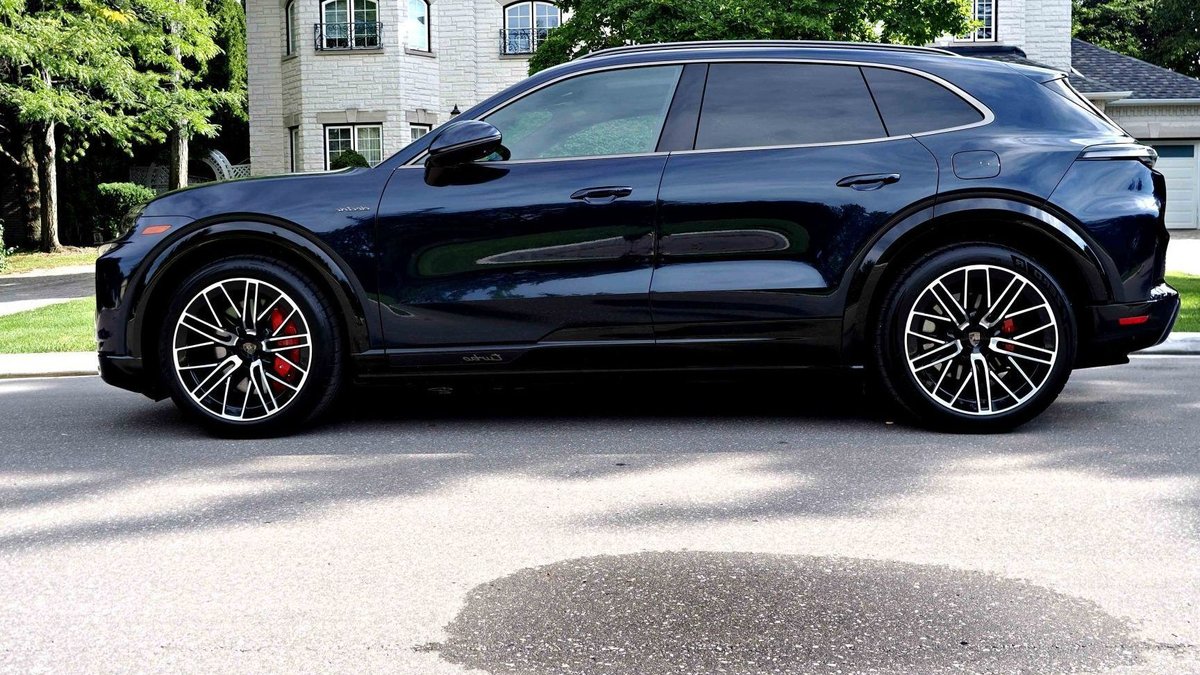
A Porsche Cayenne Turbo Electric arriving in 2026 sharpens the contrast between the automaker’s engineering ambition and its recent financial challenges. Behind the wheel, it delivers the brand’s signature intensity—though in an unexpected way. The Turbo Electric isn’t merely fast; it defies conventional physics. Without engaging the push-to-pass button or Launch Control, it still unleashes 844 horsepower, making even routine acceleration feel like a high-speed ride. Pressing the button raises output to 1,018 horsepower—a force that visibly tightens the seat’s mounting bolts. With Launch Control activated, the figure climbs to 1,139 horsepower, matching the raw power of Porsche’s Taycan Turbo and Rimac Nevera while retaining the SUV’s brute-force character.
Despite its size, the Cayenne Turbo Electric handles with surprising agility. Porsche’s engineers have balanced its 5,982-pound curb weight into a package that feels nearly nimble. On a skid pad, it achieves 1.05 g’s of lateral acceleration—equaling Ferrari’s Purosangue, often called the best-handling SUV ever tested. The 285/40ZR22 Pirelli PZero tires provide aggressive grip, though they would wear quickly under heavy track use.
The vehicle also delivers practicality alongside performance. It comfortably seats five, accommodates bulky cargo like hockey bags, and absorbs rough roads without disturbing passengers. Its 113-kWh battery, 108 kWh usable, offers 450 kilometers of range on a single charge, outperforming competitors like the BMW ix5 M50, which manages just 414 kilometers despite a slightly larger battery.
Charging efficiency is another standout. Porsche’s 800-volt architecture and nickel-manganese-cobalt-aluminum battery chemistry enable near-supercar charging speeds. The system briefly touches 400 kilowatts and sustains over 300 kilowatts from 8% to 54% state of charge, cutting a 10% to 80% recharge to 14.5 minutes. However, charging current drops sharply at 54% state of charge, and North American models use slower Tesla NACS ports, extending that 10% to 80% charge to roughly 45 minutes.
An optional wireless charging system adds convenience. Rolling over a 60-millimeter charging pad on the floor of your garage delivers 11 kilowatts for overnight top-ups, though precise alignment is required. The system includes a 15-kilogram, water-cooled receiver under the front cladding. Pricing for the full kit remains undetermined, but estimates in the EU and UK suggest costs between $12,000 and $16,000 when available later this year.
Interior design clashes with raw performance
The interior blends striking design with mixed practicality. Porsche’s curved digital gauges and vertical infotainment screen are visually compelling, but the sheer number of customizable options, four instrument layouts, six Mood Modes, five Drive Modes, and Themes, can overwhelm. High-quality materials, from supple leather to metallic trim, contrast with divisive design choices, such as the dashboard’s “spoiler” shape. The keyfob’s layout also poses issues, with the frunk button placed where the door lock typically sits, leading to frequent mispresses in low light.
Despite its supercar-level performance, the Turbo Electric retains SUV practicality. The rear seats fold flat in a 60/40 split, creating over 7.5 cubic feet of cargo space, enough for skis or strollers without a hitch. The front trunk, often overlooked in electric vehicles, holds 3.2 cubic feet, rivaling many luxury sedans. The flush loading floor eliminates bending, and trunk LED lighting illuminates contents in low light. The vehicle’s 16.8-inch ride height also simplifies entry and exit, a consideration often neglected in performance-oriented EVs.
The infotainment system runs on Porsche’s latest software, integrating third-party apps like Spotify and Google Maps. The 14.5-inch touchscreen supports gesture controls, though fingerprints and smudges frequently obscure the display after heavy use. Voice commands function but occasionally misinterpret phrases in noisy environments. Porsche’s Voice Assistant controls climate settings, media, and navigation hands-free, though it lacks the natural-language processing of competitors like Mercedes-Benz’s MBUX.
The system’s Themes feature allows drivers to customize color schemes for digital gauges, the infotainment display, and ambient lighting. Some themes, like Night or Sport, adjust brightness and contrast automatically based on ambient light. However, frequent theme switching disrupts display calibration, requiring manual recalibration of the instrument cluster. Mood Modes alter sound, steering feel, and regenerative braking, tied to the infotainment system and accessible via voice command or steering wheel controls. Sport mode tightens steering and reduces regenerative braking, while Comfort mode softens suspension and increases energy recovery.
Thermal tech and driver aids push limits
Under the floor, the thermal management system stands out. The standard heat pump improves efficiency by reducing HVAC load in cold weather.
Advanced driver-assistance systems include adaptive cruise control, lane-keeping assist, and a semi-autonomous Traffic Jam Assist up to 40 mph. The system uses cameras, radar, and ultrasonic sensors, though blind spots, particularly around rear corners, remain significant. Porsche’s InnoDrive suite integrates predictive traffic routing and eco-driving suggestions with real-time fleet data, dynamically adjusting regenerative braking and power delivery for efficiency. However, it requires manual activation in most driving modes.
Why Porsche kept a gear shifter
A notable development detail is Porsche’s inclusion of a physical gear selector despite the fully electric drivetrain. The six-position shifter, labeled D, M, S, Sport Chrono, P, and Reverse, primarily serves as a mode selector. M engages manual paddle shifters, while S activates sport mode. The tester found its placement behind the center console easily accessible without obstructing the driver’s legs. Though traditional gear ratios are absent, the shifter reinforces Porsche’s performance heritage. The paddle shifters offer a tactile way to manage regenerative braking and power delivery, reflecting the brand’s racing roots.


