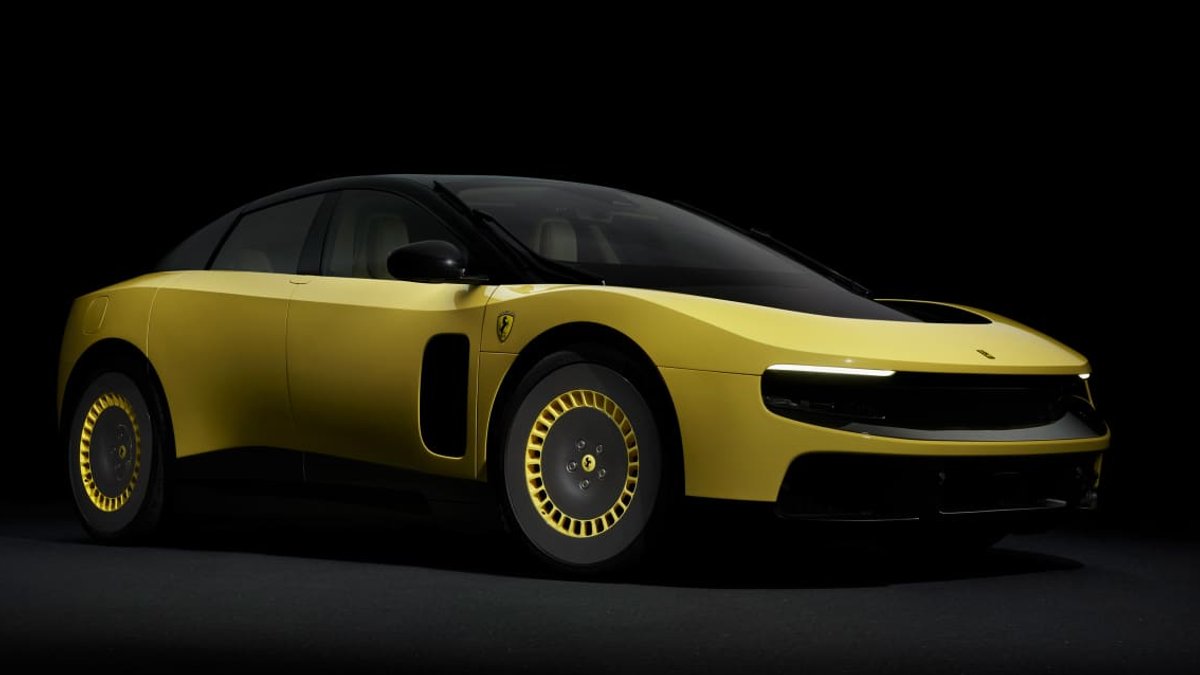
The first all-electric Ferrari arrived in Rome on May 25, 2026, 79 years after the brand’s inaugural Grand Prix win in the city. The Luce, a 1,035-horsepower four-door sedan, represents Ferrari’s most significant shift away from combustion engines.
A powertrain built for purists
The Luce’s quad-motor layout surpasses most EVs in torque vectoring. Two permanent-magnet motors on each axle, adapted from Ferrari’s hybrid F1 technology, combine to produce 1,036 horsepower. The rear axle generates 840 horsepower, while the front adds 280 horsepower and 200 lb-ft of torque. A lightweight inverter, built into the motor housing, weighs 9 kg and supports up to 300 kW.
The front-axle motors can disconnect to make the car completely rear-wheel drive when in ‘Highway’ mode on the eManettino, reducing driveline drag and maximising range. In every other drivetrain mode the front-axle motor will be engaged, making the car all-wheel drive. The 0-62mph sprint is quoted at 2.5sec, just two tenths behind the new plug-in-hybrid 849 Testarossa. Top speed is 193mph, putting it 12mph behind the 849 but a match for the pure-combustion Purosangue. Ferrari CEO Benedetto Vigna made it very clear that this is not a car built for YouTube drag races.
Design that divides opinions—and a unique wiper system
The Luce’s exterior breaks sharply from Ferrari’s traditional styling. Its cab-forward proportions and continuous glass roof create a silhouette unlike any previous Ferrari. Windshield wipers hidden in the A-pillars remain nearly invisible until activated.
Related: Alpina relaunches as independent BMW brand
The front grille uses active shutters to balance cooling and airflow, while full-width aero channels at both ends direct air efficiently. The rear lights, flush and circular, reference the 360 Modena and 458 Italia, though little else about the Luce echoes past models.
Inside, the cabin reflects the same minimalism. The absence of a central transmission tunnel allows a fifth seat, a first for the brand. Rear-hinged doors open automatically. The boot exceeds the Purosangue’s capacity, and materials like anodized aluminum, leather, and Corning glass meet tolerances more common in high-end electronics than cars. Over 100 machined aluminum parts and 40 glass components fill the interior, each treated as a standalone product.
The steering wheel includes physical controls for the Manettino and other functions. The central infotainment screen rotates and tilts via an aluminum handle, and the entire dashboard moves with the steering column. Even the seat rails, modeled after the Daytona’s, match the finish of visible surfaces.
Battery and sound innovations
The Luce’s 122 kWh battery pack, assembled at Maranello, is the most energy-dense in any production EV at 195 Wh/kg. Weighing 626 kg, it uses 14 nickel-manganese-cobalt pouch cells per module, with 85% of the 15 modules positioned below the floor. The rest sit under the rear seats, achieving a 47:53 weight distribution. Ferrari’s choice to avoid a “cell-to-pack” design enables individual module replacement if degradation occurs unevenly.
Related: Bilproblemer som må løses med en gang
Despite advanced aerodynamics, the EPA-estimated range reaches 329 miles. Ferrari claims this figure reflects real-world feedback rather than idealized testing. The performance tires contribute to efficiency without sacrificing grip.
The sound system takes an unconventional approach. Instead of mimicking a V12, it amplifies the powertrain’s actual vibrations through an accelerometer on the rear motor casing. The system filters out unwanted noise, preserving only the authentic sounds of torque shifts and traction breaks. A 3,000-watt, 21-speaker setup—featuring “ultra-flat” headliner speakers and exterior emitters—projects sound both inside and outside the car. Engineers tested 50 locations before selecting the final pickup spot, with a team of 20 specialists refining the placement.
The chassis adapts the Purosangue’s 48V Multimatic active suspension but reduces weight by 2 kg per corner. A thermocouple in each damper maintains consistent lubricant viscosity, while a suspended rear subframe minimizes noise and vibration. Carbon-ceramic brakes (390 mm front, 372 mm rear) are assisted by up to 0.68G of regenerative braking, recovering 500 kW of energy at peak deceleration.
Ferrari states the Luce feels 450 kg lighter than its actual weight, thanks to independent four-wheel steering, Side Slip Control X, and a “semi-virtual” front suspension that shifts the steering axis closer to the wheel center. Customer deliveries begin later this year, with a base price expected around £450,000.


