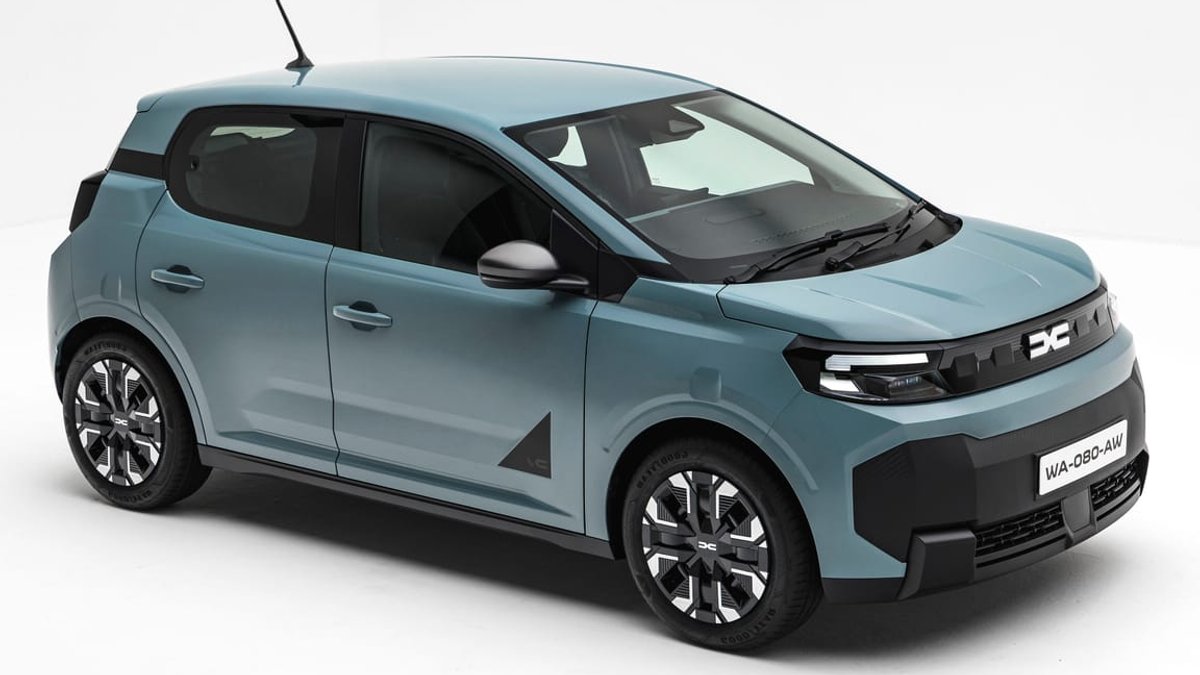
Dacia’s updated Spring model retains its reputation as an affordable electric vehicle while introducing significant improvements. The car is now wider, longer, and more powerful, yet its price remains under £18,000 before government incentives—solidifying its place as one of the most budget-friendly new EVs available. The redesign builds on Dacia’s long-standing strategy of offering maximum value, now reinforced by sharing its platform with Renault’s RG-EV Small architecture, which underpins the Renault 5, Renault 4, and Alpine A290. This shared foundation not only brings proven engineering but also ensures manufacturing efficiencies that help keep costs low while improving build quality.
The new Spring shares its underpinnings with the Renault 5, Renault 4, and Alpine A290, a change that contributes to greater refinement and structural weight. While the previous model weighed under a tonne, the updated version now measures 1,212kg—over 200kg heavier, a consequence of the more robust RG-EV Small platform and additional safety features.
Despite this added mass, Dacia claims improved efficiency at 4.9 miles per kWh, paired with a larger 27.5kWh LFP battery that delivers 79 horsepower, up from previous versions offering 69 or 99 horsepower. The battery chemistry remains LFP, known for its durability and safety, while the increased capacity reflects Dacia’s focus on balancing performance with real-world practicality. The power output now matches that of the Renault Twingo Electric, ensuring competitive acceleration for an urban-focused vehicle.
A 0-62mph acceleration time of 12.1 seconds positions it faster than the older entry-level Spring 70 but slower than the outgoing Spring 100. For most drivers, however, acceleration takes a backseat to range. Dacia’s research indicates that typical urban trips average just 13 miles at 13mph, comfortably within the 155-mile WLTP range, which translates to roughly a week’s worth of commuting for the average Spring owner.
Charging flexibility remains a strong point, with a three-pin plug capable of delivering 15-80% charge in nine hours, while a 50kW fast charger achieves the same in 28 minutes. Dacia also specifies that a 7kW home charger can replenish the battery from 15% to 80% in approximately 2 hours and 55 minutes, making overnight charging practical for most urban drivers.
Redesigned for safety and practicality
The exterior design adopts a more angular, utilitarian aesthetic, featuring a pronounced front end that Dacia argues enhances safety in city driving. The lower front bumper now extends further forward, creating a protective “bulldog jaw” that improves pedestrian safety in low-speed collisions. Wheel options include 15-inch or 16-inch rims, and the interior now features a 10.1-inch touchscreen on higher trims, three physical dials for climate and media controls, and a 7-inch driver display that integrates speed, navigation, and vehicle status.
The dashboard design prioritizes clarity, with a minimalist approach that avoids overwhelming the driver. Storage capacity has also improved, with a boot expanding to 1,283 litres when seats are folded, alongside a small front boot—useful for everyday items like shopping bags or tools. The YouClip accessory system, a feature of the Spring, allows for customizable storage solutions, while V2L (vehicle-to-load) charging enables the Spring to power external devices during emergencies.
Standard equipment includes the YouClip accessory system and V2L vehicle-to-load charging. Two trims, Expression and Journey, cater to most buyer needs, with four color choices: light blue, grey, black, and white. The Expression trim comes with 15-inch steel wheels, central locking, electric mirrors, air conditioning, and fabric upholstery, while the Journey trim adds 16-inch steel wheels, a reversing camera, the 10.1-inch touchscreen, a luggage cover, and upgraded upholstery. Final pricing has yet to be confirmed, but Dacia guarantees the model will remain under £18,000 before grants, ensuring it stays competitive.
Why buyers may ignore the weight gain
The added weight and reduced top speed may go unnoticed by most buyers. Instead, they will likely prioritize the vehicle’s affordability, expanded space, and its continued status as one of the cheapest EVs on the market. The platform update introduces more sophistication, but the core value proposition remains unchanged: a practical, low-cost electric vehicle suited for urban commuting. The Spring’s dimensions, now 18cm wider and 15cm longer than before, position it slightly larger than competitors like the Fiat 500e, offering more interior room without sacrificing maneuverability.
Dacia’s strategy hinges on the assumption that customers will overlook the increased weight in exchange for greater space, enhanced technology, and an unchanged price point. The Spring has always embodied simplicity, and this iteration merely adds features without demanding a premium. Whether this approach will be enough to stay ahead of competitors is yet to be determined.
The vehicle’s expanded interior volume, including the fold-flat rear seats and increased boot capacity, addresses a common criticism of the original Spring, which some found cramped for practical use. The addition of a reversing camera on the Journey trim further improves usability, particularly in tight urban parking spaces. Meanwhile, the retention of the three-pin charging option ensures accessibility for drivers without home charging infrastructure.
Balancing range, price, and legacy appeal
The model’s key selling points, 155 miles of range, a price cap of £18,000, and a design instantly recognizable as a Spring, remain its strongest assets. The Spring’s range is sufficient for the vast majority of urban and suburban commuters, while its price point remains unmatched in the EV segment. The design retains its distinctive, blocky character, now refined with sharper lines and a more aggressive front fascia that enhances its presence without sacrificing the playful, utilitarian aesthetic that made the original a cult favorite. The challenge will be proving that the improvements justify the shift away from the original’s ultra-lightweight approach, particularly for buyers who prioritize efficiency over additional space and features.


