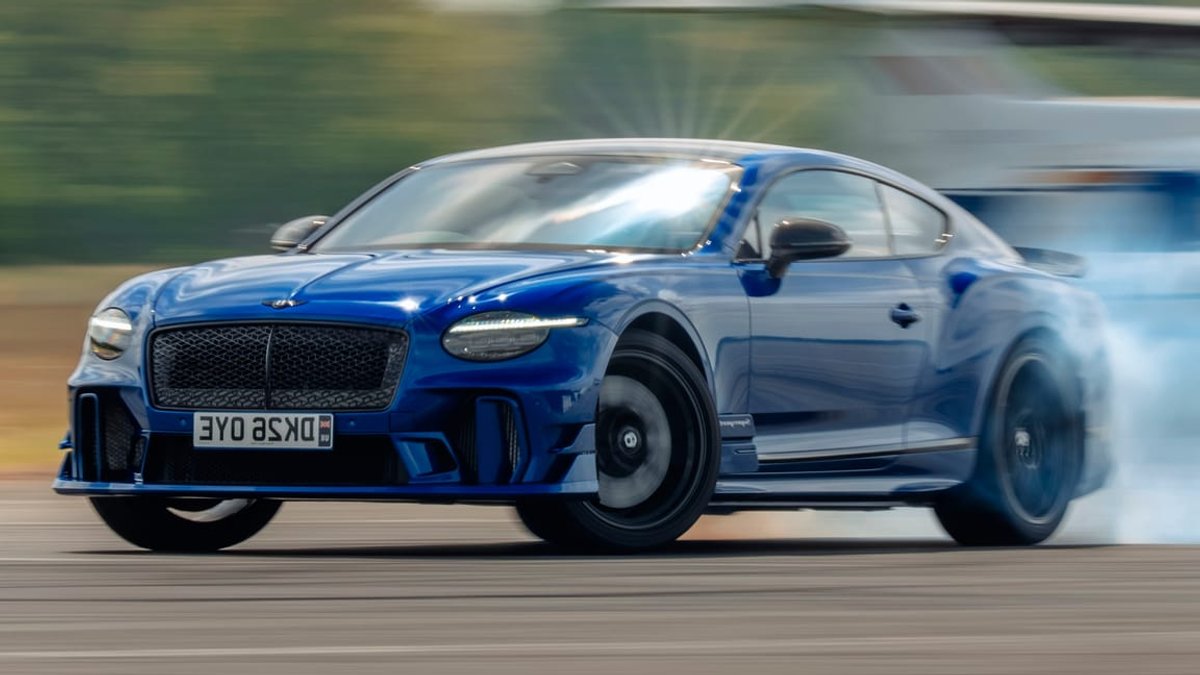
Bentley Supersports has ripped up the formula of its predecessor, positioning itself more like a Porsche than a traditional luxury grand tourer. By ditching the hybrid system, switching to rear‑wheel drive, and stripping the interior to a strict two‑seater, the automaker cut over 500 kilograms of mass.
That reduction is significant; it removes the weight of an entire Caterham Seven or nearly six average UK male adults. The resulting car is the lightest Bentley in 85 years, weighing a shade under 2,000 kg. While this might not sound featherweight next to a BMW M5, it is a drastic reduction for a brand known for opulence rather than agility.
Related: Lego builds record-breaking Koenigsegg car
Performance and Design
The Supersports produces 657 bhp and 590 lb‑ft from its 4.0‑litre twin‑turbocharged V8, trailing the Continental GT Speed’s 771 bhp and 738 lb‑ft. It can sprint from 0–62 mph in 3.7 seconds and reach a top speed of 192 mph.
Grip is impressive, with Pirelli P Zero Trofeo RS tyres delivering up to 1.3 g of lateral load. This marks a shift for the brand, which has rarely discussed cornering forces of this magnitude before.
Bentley employed carbon fibre wherever possible, including a roof that lowers the centre of gravity. The bodywork features a carbon‑fibre lower bumper with an integrated front splitter, stacked dive planes, B‑shaped “fender blades” behind the front wheels, a rear diffuser and a fixed, near‑vertical rear spoiler.
Related: Hyundai Ioniq 9 review after 18 months
Driving it is fascinating, discombobulating thanks to a centre throttle pedal, and deeply challenging due to its crash ‘box’. Synchromesh is a very good thing.
Legacy and Interior
The Supersports is not a cash‑grab limited edition; the company states it is the start of a new direction, designed to stretch the brand further.
That seems plausible when parked next to “Smoky,” a hot‑rodded version of the original Super Sports from 1925. Number 12 of 18 cars, “Smoky” has a fascinating history, having been upgraded to a 4.5‑litre engine in 1932 by its second owner, Kit Baker‑Carr. The 4.5‑litre unit, known as EXP5, even powered the Le Mans‑winning Bentley in 1928.
Related: Skoda to rebrand England’s Lake District
Despite the focus on performance, the interior retains Bentley’s core values.
In that context, the new Supersports seems a more natural exploration of Bentley’s most dynamic side.


