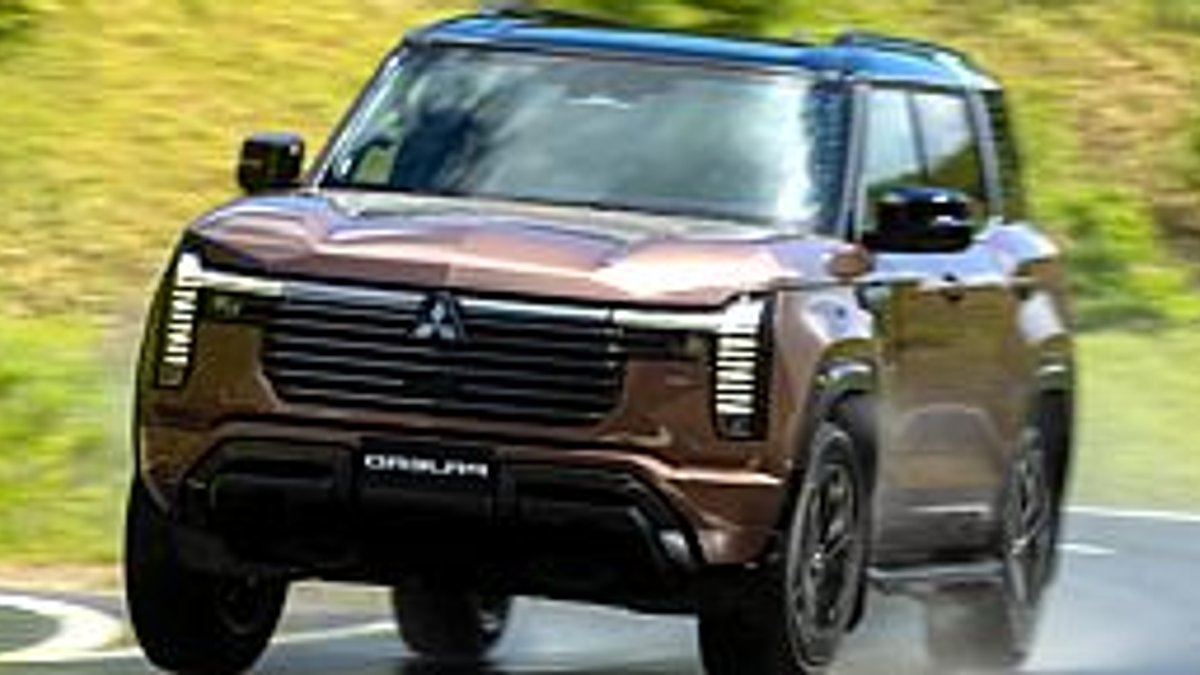
Mitsubishi is reviving its Pajero nameplate with a larger, more sophisticated SUV designed to compete in Australia’s large four-wheel drive market. The new model directly addresses customer feedback on its predecessor, the Pajero Sport.
Customer Feedback Drives Design Changes
Speaking at a preview drive, Mitsubishi Motors Australia Limited (MMAL) Pajero product strategy manager Rod Pinedo acknowledged that criticism of the Pajero Sport’s interior size heavily influenced the new vehicle’s development. The company listened to concerns that the Pajero Sport was not as wide or spacious as key competitors.
“What we’ve had over the past 10 years is feedback on the Pajero Sport being not big enough,” Mr. Pinedo explained. “The width hasn’t been as good as competitors, so that’s basically been part of the development process for this new Pajero, to be able to provide that to customers.”
The new Pajero is built on a ladder-frame platform shared with the latest Triton utility, but Mitsubishi insists it offers a distinct driving experience. The goal was to combine the off-road prowess of the Pajero Sport with the comfort and touring capability of the original Pajero.
Work on the new model began seven years ago. “We’ve been working on Pajero for seven years, and the brief was to deliver on that promise of what the Pajero name means of refinement and comfort without compromising any of the off-road capability,” Mr. Pinedo stated.
Balancing Capability and Comfort
The result is a vehicle intended to appeal to a wide range of buyers, including traditional off-road enthusiasts, touring families, and those seeking a substantial alternative to conventional all-wheel drive SUVs. Mitsubishi believes customers now choose vehicles based on their intended use, a philosophy that shaped the Pajero’s design.
Mr. Pinedo noted that significant engineering effort was put into improving ride and handling, noise, vibration, and harshness (NVH) isolation, and overall cabin comfort. “This vehicle has been thought of and designed to deliver that, to be able to be used for any person that would like to take it anywhere,” he said.
Despite sharing its underpinnings and engine family with the Triton, the Pajero features several key differences. It uses an eight-speed automatic transmission instead of a six-speed unit and employs a five-link coil-sprung rear suspension instead of the ute’s leaf springs. Revised steering, suspension, and advanced electronic traction management systems have also been incorporated.
Read Also: Mercedes-Benz launches third-gen CLA Shooting Brake in Australia
The Pajero is powered by a 2.4-litre turbo-diesel engine producing 150kW and 480Nm. It offers a 3500kg braked towing capacity and comes standard with low-range gearing and a rear differential lock across the entire range. Pricing for the new model starts at $68,490 plus on-road costs for the five-seat GLS, rising to $84,990 + ORC for the seven-seat GSR flagship.
When asked about the possibility of a cheaper, two-wheel drive variant, Mitsubishi pointed to its current-generation Outlander, which already fulfills that role for the brand. “At this stage, the Pajero, because of its name, has been considered as a true off-roader rather than a two-wheel drive,” a spokesperson said. The company is preparing an extensive, locally-developed accessory range to support the vehicle’s launch later in the year.
A Market Position Built on Distinction
The new Pajero enters a highly competitive segment against established rivals like the Toyota LandCruiser Prado, Ford Everest, and Isuzu MU-X. Mitsubishi is confident that its emphasis on a blend of off-road prowess and on-road comfort will carve out a unique space for the vehicle.
Market Position and Strategy
The outgoing Pajero Sport was less expensive, topping out at $64,840 +ORC. Mitsubishi believes the new vehicle’s additional refinement, larger cabin, and improved capability justify its positioning in a more competitive segment.
The company has confirmed it will not offer a cheaper, two-wheel drive variant. Mitsubishi is determined to maintain a clear separation between its conventional family SUV range and the Pajero’s more specialised touring and recreational brief.
The objective is to have all Australian-developed accessories available, including new ones especially for towing and off-roading. Mitsubishi has previously indicated that more than 3000 prospective customers pre-registered their interest in the new Pajero ahead of its local launch.
Commitment to a Full-Time Four-Wheel Drive Offering
The return of the Pajero nameplate follows its departure in 2021, when the smaller Pajero Sport served as Mitsubishi’s primary conventional four-wheel drive wagon. The new model’s larger cabin and increased refinement are direct responses to the growing size and sophistication of its key competitors.


