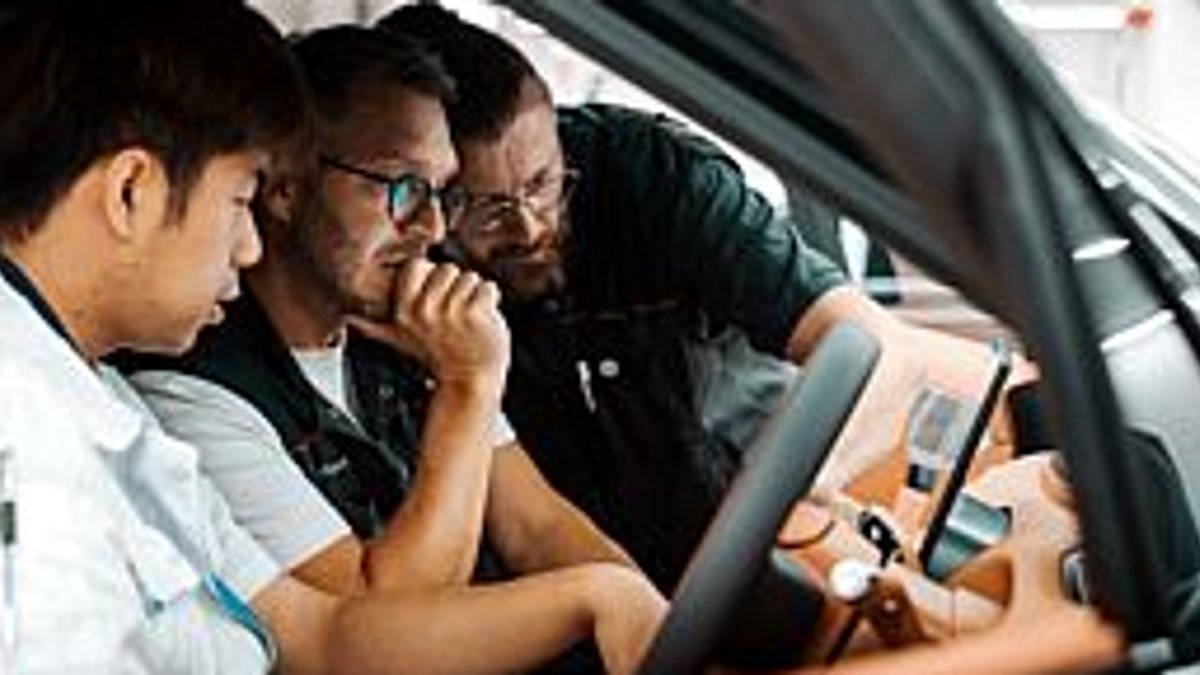
Western carmakers are increasingly turning to Chinese brands for technology partnerships, according to XPeng president and vice-chairman Brian Gu. This shift is driven by the need to absorb learnings from Chinese companies and leverage their development capabilities.
Speaking on the sidelines of the launch of the right-hand-drive XPeng L03 in the United Kingdom, Mr Gu, XPeng’s number-two executive globally, was asked whether European manufacturers would increasingly need to lean on their Chinese partners, especially considering the Volkswagen China export decision. “It’s not just Volkswagen. Pretty much every OEM is in Europe or in Asia as well, looking at Chinese partnership, how to leverage Chinese development capabilities, how to leverage the market know-how,” he explained.
Volkswagen is one such company, gearing up to export technology developed collaboratively with XPeng beyond China into Australian showrooms. The two carmakers have a partnership that began in 2023 with Volkswagen’s $700 million purchase of a 4.99 per cent stake in XPeng.
Reversal of the Old Hierarchy
This arrangement reflects a reversal of the old automotive hierarchy, where Western brands once supplied tech to Chinese joint ventures. Now, European companies are buying access to Chinese engineering speed and platforms, and often for top dollar.
The partnership between Volkswagen and XPeng covers two Volkswagen-badged electric vehicles, including the ID. Unyx 08 SUV, which entered production in March. XPeng supplies the underlying EV platform, plus smart cockpit and driver assistance technology.
Volkswagen holds 75 per cent of the Anhui manufacturing joint venture, giving it majority control over production facilities.
Collaboration and Engineering
The collaboration has jointly developed Volkswagen’s China Electronic Architecture (CEA) zonal electrical platform, with a simplified computing architecture and more rapid software update capability. This platform is set to be used in vehicles destined for emerging overseas markets, including Australia.
Volkswagen says localised Chinese development can cut timelines by up to 30 per cent. The ID. Unyx 08 moved from design to production in around 24 months.
However, the ID. Unyx 08 is struggling on the sales charts in China, averaging just 267 monthly deliveries between April and August this year. Exporting these models to overseas markets like Australia is one tool that could be deployed to absorb spare capacity.
Cooperation and Emissions Rules
Tough Australian emissions rules provide another reason for Western brands to cooperate with Chinese companies. Earlier this year, Geely Australia chief executive Alex Gu said that legacy manufacturers facing New Vehicle Efficiency Standard (NVES) penalties could either invest heavily in low-CO2 platforms or purchase access to established Chinese platforms. “If I’m the owner of a legacy brand, I think the second way is more efficient,” he said.
Stellantis acquired roughly 21 per cent of China’s Leapmotor and now oversees 51 per cent of the venture’s international sales and manufacturing, focusing on overseas distribution rather than licensing.
The venture reported more than 40,000 European shipments last year.


